

Internal Roof Insulation with Naturheld
Internal Roof Insulation
- Breathable, hygroscopic and capillary-active insulation so water vapour can pass through the insulation, keeping the roof timbers dry
- Wood fibre buffers moisture so keeps relative humidity at optimum levels
- Excellent thermal mass properties so significantly reduces summertime overheating in lightweight roof structures
- Acoustic insulation through the roof will be enhanced due to high density and fibrous structure of the wood fibre
- Thermal bridging eliminated if the wood fibre boards are fitted to the underside of the rafters
- Naturheld 220/180/140 have tongue & groove joints to reduce risk of thermal leakage
- Carbon-negative and natural, sustainable insulation – safe to handle
- Can be finished with plasterboard or Baumit lime plaster
Jump to your preferred option by choosing one of the below:
Pitched Roof
Option 1: Existing Pitched Roof with Internal Roof Insulation - Rafters 100mm Deep (min)
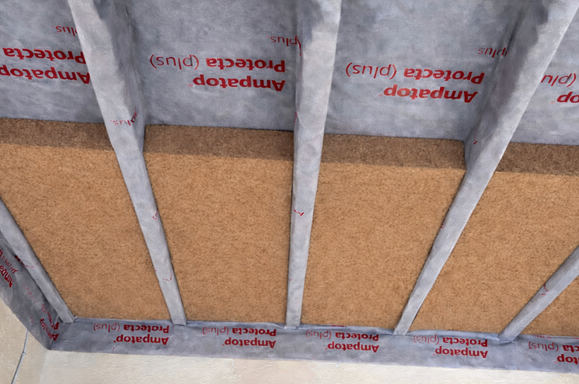
Naturheld 220/180/140 wood fibre boards and Naturheld Flex flexible insulation batts are ideal to use as Internal Roof Insulation between, and under, the rafters. Naturheld 220/180/140 wood fibre boards are water-resistant, so can be used between the rafters, maintaining the required 50mm ventilation space above the insulation. Alternatively, the Ampatop Protecta Plus Breather Membrane can be draped under, and between, the rafters to keep the flexible wood fibre insulation dry. Naturheld Flex isn’t water-resistant so must be protected from condensation that may drip from the underside of the cold roof tiles.
U-value examples are shown below.
Existing Roof
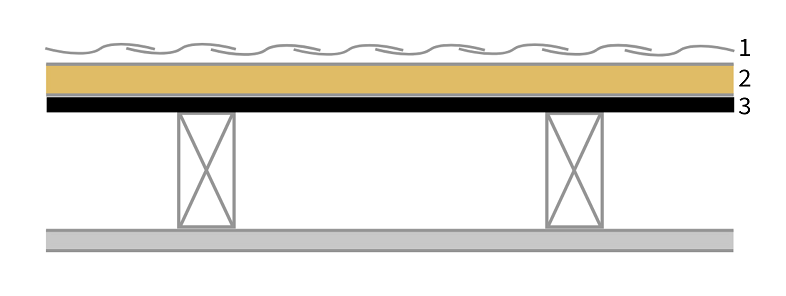
Baseline Roof
Option 2
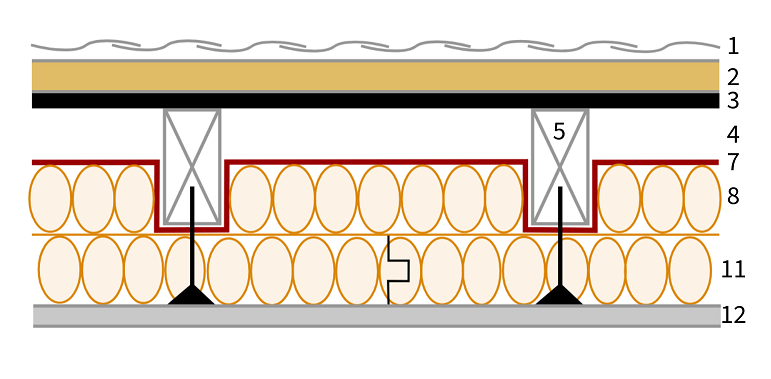
Better U-Value – Rafters Not Extended – Naturheld wood fibre insulation between, and under, rafters. Rafters could also be extended to further improve the U-value.
Option 1
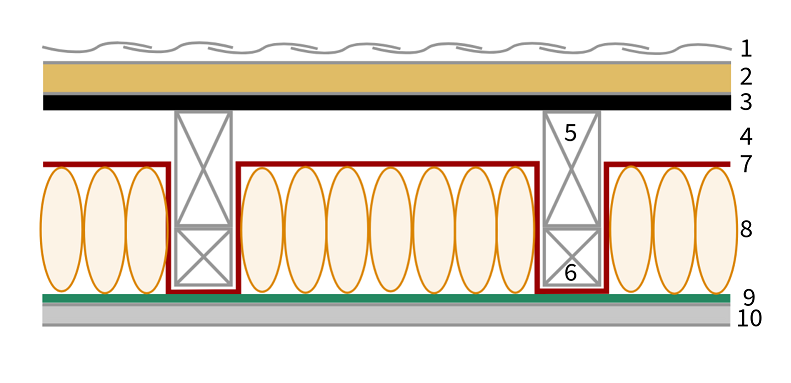
Reasonable U-Value – Rafters Extended – Insulation between rafters only
Option 3
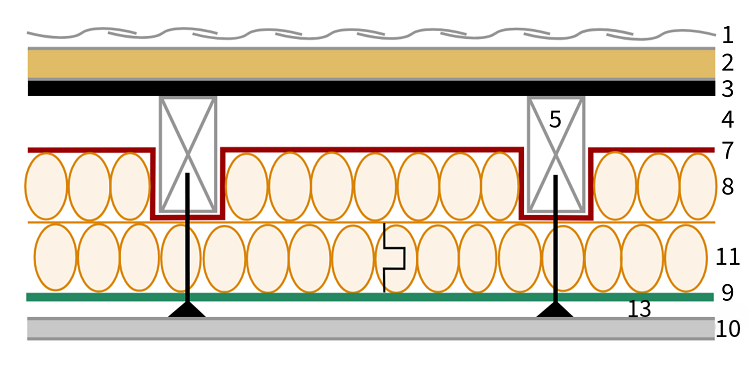
Better U-Value – Same as Option 2, but also including a Services Void, if required. Rafters could also be extended to further improve the U-value.
Internal Roof Insulation on Pitched Roof with 100mm min. Deep Rafters
- Existing Roof Tiles or Slates
- Existing Tile Battens or Sarking Board
- Existing Roof Felt or Bitumen
- 50mm ventilated space created by bonding 50mm high timber battens to top sides of rafters. Use AMPACOLL RA GLUE to bond.
- Existing rafters – 100mm high min.
- Optional: Extended rafters
- AMPATOP PROTECTA PLUS Breather Membrane draped under, and up along sides of rafters, so that the insulation will be protected from condensation dripping from underside of cold roof covering
- NATURHELD FLEX flexible insulation friction-fitted between rafters (extended or not)
- AMPATEX VARIANO 3 Moisture Variable Airtightness Membrane
- 12.5mm Plasterboard and skim
- NATURHELD 220/180/140 wood fibre T&G boards screwed to underside of rafters
- 8mm Baumit lime plaster finish (2 coats with mesh)
- New battens under NATURHELD 140/180/220 to make a Services Void, if required
Internal Roof Insulation on Pitched Roof with 100mm min. Deep Rafters
Existing Roof

Baseline Roof
Option 1

Reasonable U-Value
Rafters Extended – Insulation between rafters only
Option 2a

Better U-Value
Rafters Not Extended – Insulation between and under rafters
Option 2b

Same as 2a, but also including a Services Void, if required
Option 3a

Best U-Value
Rafters Extended – Insulation between and under rafters
Option 3b

Same as 3a, but also including a Services Void, if required
- Existing Roof Tiles
- Existing Tile Battens or Sarking Board
- Existing Roof Felt or Bitumen
- New 50mm high timber battens fixed to top sides of rafters to create a 50mm ventilated space
- PAVATEX PAVACOLL Glue to bond battens to rafters
- 30/40mm ISOLAIR MULTI water retardant wood fibre boards cut to fit between rafters – screwed to underside of battens
- PAVAFLEX (50 / 80 / 100 / 140mm) or PAVATEXTIL P (45 / 80 / 100 / 145mm) flexible insulation friction fitted between rafters (extended or not)
- PAVATEX DB 3.5 Airtightness Membrane
- 12.5mm Plasterboard and skim, if desired
- ISOLAIR MULTI wood fibre screwed to underside of rafters (if plaster finish is required)
- 8mm Baumit lime plaster finish (2 coats with mesh)
- PAVATHERM (40-140mm) wood fibre square edged boards (if plasterboard finish is required)
- New battens under PAVATHERM joints perpendicular to rafters
Alternative Option
NATURHELD 220/180/140 can be fitted between the rafters instead of the Ampatop Protecta Plus Breather Membrane and Naturheld Flex. Naturheld 220/180/140 boards are water-resistant, so any condensation that may drip from the underside of the cold roof covering will run down the top of the wood fibre board and will evaporate away. NATURHELD FLEX can optionally be fitted below these Naturheld boards down to the bottom of the rafters.
It is critical to maintain a 50mm ventilated gap above the Naturheld 220/180/140 wood fibre boards. This gap is achieved by bonding 50mm high timber battens to the top sides of each rafter, using AMPACOLL RA GLUE. The wood fibre board is screwed to the underside of these battens.
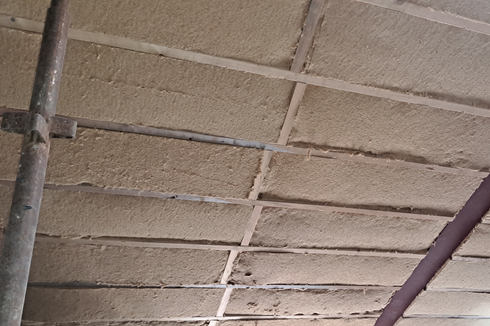
We can supply all the relevant products below.
- Leave roof tiles or slates, horizontal tile-battens, sarking board, roof felt etc in place. Ensure there is good ventilation at the eaves, and it is also good to have it at the ridge too.
- Glue 50 x 50mm (HxW) timber battens to either side of the top of the rafters using AMPACOLL RA GLUE - this provides the minimum 50mm required ventilated space.
- Drape the AMPACK AMPATOP PROTECTA PLUS Breather Membrane under a rafter, up along the side of the rafter as far as the 50x50mm batten, then pull across the empty space, and bring back down the side of the next rafter. The membrane can be stapled or bonded (using AMPACOLL RA GLUE or AMPACOLL BK 530 double-sided tape) to keep it in place. See Drawings above. This breather membrane will keep the Naturheld Flex dry. The required 50mm ventilation space will be above the membrane.
- Friction-fit the 575mm wide NATURHELD FLEX flexible wood fibre batts snugly between the rafters so that they fully fill the space between the membrane and the bottom of the rafters. The rafters can be optionally extended. The Flex may need to be cut to fit between narrower spaces. Cut with an insulation knife or a hand saw / alligator saw with a serrated blade. It is recommended to wear a dust mask for protection.
- OPTIONAL for Lower U-values: Screw NATURHELD 220/180/140 wood fibre boards to the bottom of the rafters to improve the insulation (using Rawlplug R-PTX 6 fixings with KC Washers). These Naturheld boards will break the thermal bridge through the rafters.
- OPTIONAL - PLASTERED FINISH: NATURHELD 220/180/140 T&G boards can be plastered directly with Baumit RK70 lime plaster, inserting a Reinforcing Mesh into the base coat. Baumit RK70 or Klima Glatt can be used as the top coat. The lime plaster will provide airtightness.
- OPTIONAL - PLASTERBOARD FINISH: Fit AMPATEX VARIANO 3 Moisture Variable Airtightness Membrane to the underside of the rafters, or to the underside of the Naturheld 220/180/140 boards, and bond it well to the perimeter walls. Optionally install 25mm battens to make a Services Void and fix Plasterboard or Fermacell finishing board to the battens only to prevent cold spotting.
ALTERNATIVE METHOD:
- Cut NATURHELD 220 (22mm), 180 (40mm) or 140 (60mm +) water-resistant wood fibre T&G boards so that they fit snugly between the rafters. Screw these to the underside of the timber battens using Rawlplug R-PTX 6 fixings with KC Washers. These Naturheld 220/180/140 boards replace the breather membrane.
- Fit NATURHELD FLEX below the Naturheld boards so that it fully fills the space between the rafters. The rafters can be optionally extended.
- OPTIONAL: Fit NATURHELD 220/180/140 wood fibre boards to the underside of the rafters for improved U-values.
- Finish with lime plaster or an airtightness membrane and plasterboard as outlined above.
- AMPACOLL FLEXX PRO TAPE – Tape for bonding membranes to all substrates and for bonding membrane ends to each other
- AMPACOLL PRIMAX to prime dusty surfaces or wood fibre before bonding tape to it
- AMPACOLL RA ADHESIVE – Adhesive for sealing 50x50mm battens to rafters and for sealing membrane to rafters
Downloads
- Naturheld Wood Fibre Flyer
- Information Sheet – Naturheld 140,180,220
- Information Sheet – Naturheld Flex
- Data Sheet – Ampatop Protecta (plus) Breather Membrane
- Data Sheet – Ampatex Variano 3 Airtightness Membrane
- Data Sheet – Baumit RK70 Base Coat & Bond Coat
- Data Sheet – Baumit Klima Glätt W (RK30) Smooth Finishing Coat
Option 2: Existing Pitched Roof with Internal Roof Insulation - Rafters 75mm Deep (max)
Naturheld 220/180/140 wood fibre boards can be used as Internal Roof Insulation under rafters that are only 75mm deep or less. A 50mm ventilated space must be maintained above the insulation, so there would not be adequate space left to also include insulation between the existing rafters. As a result, we recommend that Naturheld 220/180/140 is fitted directly below the rafters. Naturheld 220/180/140 boards are water-resistant and have tongue and groove joints, so this will ensure that no condensation will drip down into the insulation – instead it will roll down on the surface and evaporate away. The Naturheld 220/180/140 can be finished with lime plaster or plasterboard, or for a better U-value, new battens can be fitted below the rafters, which can then be filled with flexible insulation.
U-value examples are shown below.
Existing Roof
Baseline Roof
Option 1

Better U-Value and Airtightness
With Naturheld Wood Fibre Insulation and Baumit Lime Plaster below rafters
Option 2

Better U-Value and Airtightness
With Naturheld Wood Fibre Insulation, Airtightness Membrane, Services Void and Plasterboard below rafters
Internal Roof Insulation on Pitched Roof with 75mm max. Deep Rafters
- Existing Roof Tiles or Slates
- Existing Tile Battens or Sarking Board
- Existing Roof Felt or Bitumen
- 50mm min. ventilated space – existing space between rafters left empty
- Existing rafters
- –
- –
- –
- AMPATEX VARIANO 3 Moisture Variable Airtightness Membrane under insulation – well taped
- 12.5mm Plasterboard and skim
- NATURHELD 180/140 (40 – 220mm) water-resistant wood fibre boards screwed to underside of rafters
- 8mm Baumit lime plaster finish (2 coats with mesh)
- New battens under Airtightness Membrane to make a Services Void, if required
Internal Roof Insulation on Pitched Roof with 75mm max. Deep Rafters
Existing Roof
Baseline Roof
Option 1

Reasonable U-Value and Airtightness
With Insulation below rafters
Option 2

Better U-Value and Airtightness
With Insulation and Airtightness Membrane below rafters
Option 3

Best U-Value and Airtightness
With extra Insulation and Airtightness Membrane below rafters
- Existing Roof Tiles
- Existing Tile Battens or Sarking Board
- Existing Roof Felt or Bitumen
- Existing rafter left empty to create a 50mm min ventilated space
- OPTIONAL: PAVATEX ADB Breather Membrane
- ISOLAIR MULTI (30 – 200mm) water retardant wood fibre boards screwed to underside of rafters
- 8mm Baumit lime plaster finish (2 coats with mesh)
- PAVATEX DB 3.5 Airtightness Membrane
- 25mm battens to create a Services Void
- 5mm Plasterboard and skim, if desired
- 50mm min. new battens filled with PAVAFLEX or PAVATEXTIL P flexible insulation
- Ejot STR-H thermally broken fixings (40mm embedment)
- Heco Topix 6 Fixings (40mm embedment)
We can supply all the relevant products below.
- Leave roof tiles or slates, horizontal tile-battens, sarking board, roof felt etc in place. Ensure there is good ventilation at the eaves, and it is also good to have it at the ridge too.
- Due to lack of space, it is best to leave all the space between the rafters open for ventilation.
- Screw NATURHELD 180/140 (40-220mm) T&G water-resistant wood fibre boards to the underside of the rafters using Rawlplug R-PTX 6 Fixings with KC Washers for plaster finish or Rawlplug R-PTX 6 Fixings for plasterboard finish. The Naturheld 180/140 board will break the thermal bridge through the rafters.
- Optional - PLASTERED FINISH: Plaster the NATURHELD 180/140 directly with Baumit RK70 lime plaster, inserting a Reinforcing Mesh into the base coat. Baumit RK70 or Klima Glatt can be used as the top coat. The lime plaster will provide airtightness.
- Optional - PLASTERBOARD FINISH: Fit AMPATEX VARIANO 3 Moisture Variable Airtightness Membrane to the underside of the wood fibre and bond it really well to the perimeter walls. Install battens to make a Services Void, if required, and fix Plasterboard or Fermacell finishing board to battens only to prevent cold spotting.
- AMPACOLL PRIMAX to prime dusty surfaces or wood fibre before bonding tape to it
- AMPACOLL FLEXX PRO TAPE – Tape for bonding membranes to all substrates and for bonding membrane ends to each other
- AMPACOLL RA ADHESIVE – Adhesive for sealing membrane to rafters and perimeter edges
Downloads
U-Value Results
Rafters with a Minimum Depth of 100mm
Existing Pitched Roofs – Rafters 100mm min
- Roof Tiles on 25mm Tile Battens
- Rafters with top 50mm left empty to provide 50mm Ventilation Space
- Ampatop Protecta Plus Breather Membrane draped up, and between Rafters
- Naturheld Flex Wood Fibre between Rafters (optionally extended)
- OPTIONAL: Naturheld 180/140 Wood Fibre under Rafters
- Ampatex Variano 3 Moisture Variable Airtightness Membrane under wood fibre
- 25mm Services Void – uninsulated
- 12.5mm Plasterboard & Skim

| Naturheld 180/140 Thickness Below Rafters (mm) | U-Value for 80mm Naturheld Flex between 125mm Rafters (W/m²K) | U-Value for 100mm Naturheld Flex between 150mm Rafters (W/m²K) | U-Value for 130mm Naturheld Flex between 175mm Rafters (W/m²K) | U-Value for 180mm Naturheld Flex between 225mm Rafters (W/m²K) |
|---|---|---|---|---|
| No Insulation below Rafters | 0.46 | 0.38 | 0.31 | 0.23 |
| 40mm | 0.32 | 0.28 | 0.24 | 0.19 |
| 60mm | 0.27 | 0.24 | 0.21 | 0.17 |
| 80mm | 0.24 | 0.21 | 0.19 | 0.16 |
| 100mm | 0.21 | 0.19 | 0.17 | 0.14 |
* U-Value without any insulation: 2.23 W/m²K
Rafters with a Maximum Depth of 75mm
Existing Pitched Roofs – Rafters 75mm max
- Roof Tiles on Tile Battens
- Rafters left empty to provide 50mm min. Ventilation Space
- Naturheld 180/140 (40–220mm) Wood Fibre below Rafters
- Ampatex Variano 3 Moisture Variable Airtightness Membrane under Naturheld 180/140
- 25mm Services Void – uninsulated
- 12.5mm Plasterboard & Skim

| U-Value for No Insulation (W/m²K) | U-Value for 40mm Naturheld 180 Below Rafters (W/m²K) | U-Value for 60mm Naturheld 140 Below Rafters (W/m²K) | U-Value for 80mm Naturheld 140 Below Rafters (W/m²K) | U-Value for 100mm Naturheld 140 Below Rafters (W/m²K) |
|---|---|---|---|---|
| 2.23 | 0.73 | 0.52 | 0.42 | 0.35 |
Please contact us if you require other U-values calculated.
The Benefits of Internal Roof Insulation
Internal Roof Insulation with Wood Fibre
Internal roof insulation is an excellent solution for improving your home’s energy efficiency when renovating an existing roof without removing the roof tiles or slates. If the roof covering is being replaced, however, we recommend installing external roof insulation above the rafters for the best thermal performance.
Insulating at rafter level is ideal when the attic has been converted into a bedroom, office or living space, or where the property has vaulted ceilings. If the attic is only used for storage, insulating the loft floor is usually the more cost-effective option.
Why Choose Wood Fibre Roof Insulation?
Wood fibre insulation offers far more than excellent thermal performance. It is a natural, breathable insulation material that helps regulate moisture, improve indoor comfort and create a healthier home.
Unlike many conventional insulation products, wood fibre allows water vapour to pass through the building structure so safely manages moisture. This helps keep roof timbers dry and significantly reduces the risk of condensation, mould, wet rot and dry rot.
To ensure the roof performs correctly, a 50mm ventilated air gap must always be maintained above the insulation. This allows any moisture within the roof structure to evaporate safely.
Reducing Heat Loss Through the Rafters
For rafters that are at least 100mm deep, the Ampack Ampatop Protecta (Plus) breather membrane can be installed beneath, and up along the sides of each rafter, while maintaining the required 50mm ventilation gap above the membrane. The remaining space below the membrane and between the rafters is then fully insulated using Naturheld Flex flexible wood fibre insulation for excellent thermal performance.
Alternatively, a thin layer of Naturheld 220/180 (22mm/40mm) boards can be fitted first between the rafters – this will replace the breather membrane. These water-resistant boards allow any condensation beneath the roof covering to drain safely and evaporate within the ventilated cavity. The remaining rafter space can be fully-filled with Naturheld Flex.
Timber rafters typically make up between 9% and 15% of the roof area. Because timber is less insulating than wood fibre, these rafters can create thermal bridges where valuable heat escapes.
Where ceiling height allows, we also recommend installing Naturheld 180/140 wood fibre boards beneath the rafters. This continuous insulation layer significantly reduces cold bridging and improves the overall thermal efficiency of the roof.
Keeps Your Home Cooler in Summer
One of the biggest advantages of wood fibre insulation is its outstanding summer heat protection.
Attic rooms often become uncomfortably hot during warm weather due to solar gain through the windows, and there being no thermal mass in the lightweight roof structure. Most low-density roof insulation materials do little to absorb this excess heat, as they also have low thermal mass.
Wood fibre insulation is different. Its high density and exceptional heat storage capacity allow it to absorb excess heat during the day and release it slowly over 10 to 12 hours. This helps keep attic rooms noticeably cooler throughout the day and night.
In comparison, many conventional insulation materials only delay heat transfer for 5 to 8 hours, when achieving the same U-value.
Warmer Homes During Winter
The same thermal mass that keeps your home cooler in summer also works during winter.
Wood fibre insulation stores warmth generated by your heating system and releases it gradually as temperatures fall overnight. This helps maintain a more consistent indoor temperature, improving comfort while reducing heating demand.
Excellent Acoustic Performance
Wood fibre insulation doesn’t just improve energy efficiency—it also makes your home quieter.
Its dense structure helps reduce outside noise from heavy rain, road traffic and aircraft, creating a more peaceful living environment, particularly in converted attic spaces.
A Natural, Breathable Roof Insulation System
Wood fibre roof insulation provides year-round comfort by combining:
- Excellent thermal insulation
- Outstanding summer heat protection
- Breathable moisture management
- Reduced risk of condensation and timber decay
- Improved acoustic insulation
- Sustainable, natural materials
- A healthier indoor environment
Whether you’re converting an attic or upgrading an existing roof, wood fibre insulation offers a high-performance, long-lasting solution that improves comfort in every season.

The Ideal Solution for our Built Environment and Nature